


Planning Your Commodity Order Wisely Can Help You Reach the 30% NY Threshold
Becky O'Connor, Farm to School Coordinator, WNY & Finger Lakes
Harvest New York
Article by Rosemarie Hanson, Trumansburg Central School District Food Service Director, and Gail Brisson, Trumansburg Middle School Librarian; originally submitted to FOCUS Magazine.
If you are trying to increase your purchases of local and NY State foods to achieve the 30%, the first place you should look is your commodity ordering. When you are ordering your "brown box" items next year, consider leaving off the cheddar, mozzarella cheese and the ground beef. These are three products that are produced and readily available in New York State. This is an easy switch that doesn't increase your labor costs or require any special skills to implement.
What to spend your available commodity dollars on now that you are buying NY Cheese and beef? Grilled chicken strips are a great USDA center of the plate option that are fully cooked, easy to portion, and are a versatile protein to combine with local vegetables and international flavors in dishes kids will love. Diced chicken, turkey roasts, and roasted bone-in chicken are some other protein options that are often available.
The other items to take off of your commodity order are potatoes, carrots, and apple products. Fresh apples, apple sauce, and apple juice are all available as NYS products. NYS potatoes are available pretty much year round, and kids won't get sick of them even if you serve them every week. Baking russet potatoes and steaming whole red or "salt" potatoes are simple options that don't take too much labor. Other simple preparations are chopping and roasting, either as "home fries" or oven roasted wedges. Peeling carrots does take more work than buying already prepared "baby" carrots, but local carrots are often sweeter and will last a long time in the cooler. What to spend your available commodity dollars on now that you've eliminated these fruits and vegetables? Put your leftover dollars into the FFAVORS program or the Pilot program to buy produce that you can't buy locally, like oranges, or lettuce out of season.
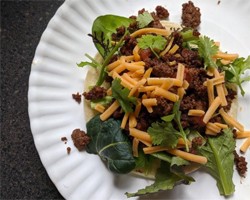
Still not at 30%? Try increasing the frequency with which you serve NY items. Cheese is a pretty cost effective protein that kids love. Make your own "speed scratch" pizza with premade whole grain rich pizza shells, canned sauce, and NY mozzarella cheese, and menu it every week. Homemade macaroni and cheese with NY Cheddar is pretty easy to make, and is great paired with broccoli or cauliflower. Add more Mexican dishes like quesadillas, enchiladas, or tacos that use cheddar cheese.
Items like NY Ground Beef may seem unaffordable at first glance, at 79 cents per 2 M/MA versus 51 cents for commodity beef. But by ordering chicken strips at 35 cents per serving, instead of USDA ground beef I get 50% more MMA for my commodity dollars, and they are more versatile. This goes a long way towards supporting my NY beef purchases. Another way that chicken strips can stretch my ground beef dollars is to also offer chicken taco filling when we have ground beef tacos. I have found that in some schools, more than 50% of the students choose the chicken.
By switching to NY beef, you will rapidly increase your total percentage of NY foods, and if this brings you to the 30% threshold, you will easily recoup the added expense. Local beef can also be safer for students; the beef that I get is tested for e. coli, has minimal hormones, and the source of the meat is traceable. And it happens to look and taste better than what I was getting in my commodity order.
Saving money by choosing commodity foods carefully can make room in your budget for buying local foods, and the rewards are greater than just the potential extra 19 cents per lunch; buying local supports our local economies, has a positive impact on the environment, and creates excitement and anticipation in your school lunch program.
Image credit Trumansburg CSD
Upcoming Events
Rochester Soil Health Day
September 1, 2026
4:00 pm - 7:00 pm
Rochester, NY
Join Cornell Cooperative Extension Harvest NY, New York State Soil Health, and Foodlink for interactive activities focused on soil health and an opportunity to get your garden soil screened for lead (reservation required).IPM Field Day for Urban Growers
September 10, 2026
3:00 pm - 6:00 pm
Buffalo, NY
Join us for a hands-on field day exploring integrated pest management and season extension tools for urban growing spaces and the opportunity to build community with local growers!This event will focus on best practices for using row covers and rat mitigation. Check out our CCE demonstration trial using insect exclusion netting to manage swede midge, an invasive fly that causes damage to brassica crops. Explore how to identify rat activity, reduce attractants, and strengthen site management. Hear from local growers on how they manage pests with a focus on organic management and how they extend the season on their farms and gardens.
Resilient Gardens Conference
September 18 - September 19, 2026
Fri: 9:00 am - 5:00 pm; Sat: 9:00 am - 1:00 pm
Poughkeepsie, NY
The third Resilient Gardens Conference will focus on culturally relevant gardening skills and community garden management for the unique resource needs of urban gardeners. This two-day event will feature education and practical skills on day one; we'll hear from leaders of diverse stakeholder groups on strategies to overcome these issues in cities and rural communities and connecting resources between Cornell Cooperative Extension and leading community gardens. The second day is optional and will include tours of local gardening projects across Poughkeepsie and Kingston NY. This event is primarily open to Seed to Supper Garden Educators, CCE Educators, Master Gardener Volunteers and Upstate Seed to Supper Program Participants, as well as partner Community Gardens involved with Harvest NY.